


By Amal
Geosentiment, identity, and rationality
Every day we hear phrases that seem obvious: “This land is ours,” “these resources belong to us,” “this identity must be defended.” These are words that give a sense of security, especially in uncertain times. But they are also often the same words that justify violence, exclusion, and closure.
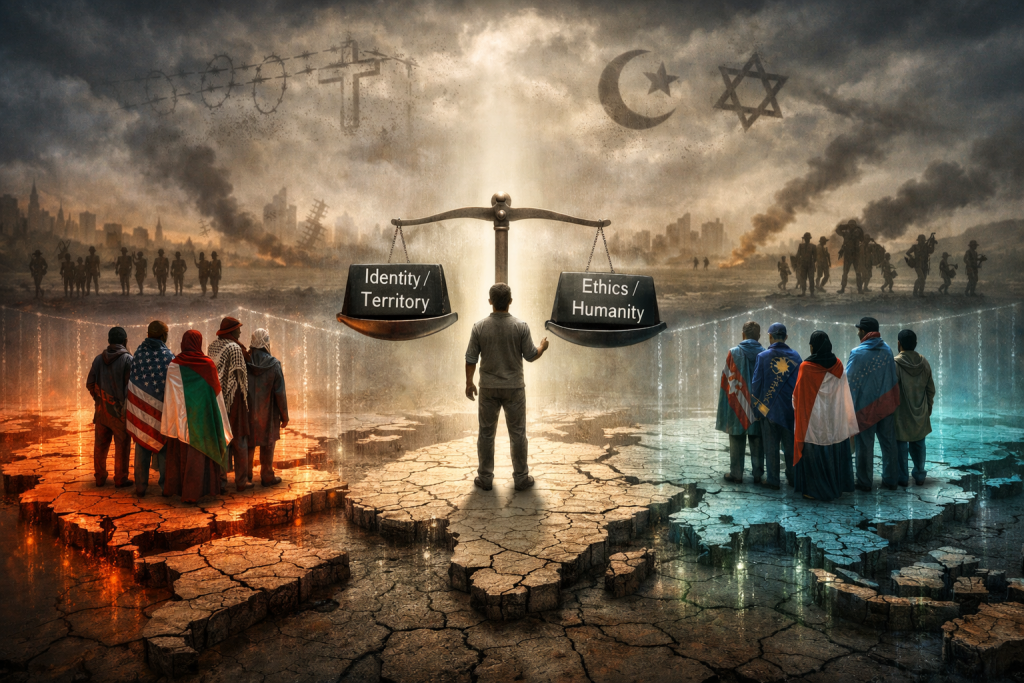
When identity ceases to be a starting point and becomes an absolute criterion, something gets stuck. This is where a mental mechanism comes into play that is not very visible but very powerful. Indian philosopher and social reformer Prabhat Ranjan Sarkar called this mechanism geosentiment. By this term, Sarkar means a form of emotional attachment to a place, a territory, a “here,” which takes the place of rational evaluation. It is not the natural affection for one’s land or culture, but a more subtle transition: the moment when ‘where’ becomes more important than “does it make sense.”
In this logic, decisions are no longer made by asking whether something is right, useful, sustainable, or whether it harms someone else. Rather, concepts of territorial belonging and cultural identities linked to the individual region in which one lives are affirmed. When this happens, rationality is suspended. And what follows is no longer a choice, but a reaction.
This is a dynamic we see every day: geosentiment is not a theoretical abstraction but a reality that cuts across many contemporary conflicts.
We see it when territories are occupied or defended with violence because they are considered “legitimate” by historical, religious, or identity rights. We see it when armed groups attack civilians, convinced that the cause makes any means acceptable. In these cases, the territory ceases to be a space to be shared and becomes a sacred symbol, for which people are willing to suspend all universal ethical criteria.
The mechanism is often mirrored: the sides change, but the logic remains the same. When “us” becomes absolute, the other ceases to be a person and becomes an obstacle.
The same logic also applies in economics and politics. Material interests are cloaked in identity or geopolitical language: natural resources such as oil or strategic minerals are contested not on the basis of the good of the populations involved, but in the name of territorial belonging.
Decisions are thus made that do not answer the question “is it useful and right?”, but another, simpler and more dangerous one: “is it ours?”.
In many areas of the world, particularly in various African contexts, this logic produces armed borders, recurring conflicts, and chronic instability. Those who flee these situations are often treated as a problem, rather than as the direct effect of policies based on appropriation and exclusion. The “us” defends itself by building walls, while the consequences are dumped on those who have less of a voice.
According to Sarkar, one of the most serious effects of geosentiment is the reduction of what should be an ethical law valid for everyone to a local and territorial form.
To indicate this universal ethical principle, Sarkar uses the term Dharma. Not a religion, but the set of criteria of justice, responsibility, and respect that should apply everywhere and to every human being. The problem arises when this broad vision is narrowed down to a local religion, a “sacred” place, or a particular tradition. At that moment, what should unite becomes a cause for separation. Geography takes the place of moral judgment.
At this point, Sarkar introduces a decisive clarification: rationality is not a cold or inhuman attitude. It is what protects a profound dimension of the human being. Sarkar speaks of devotional feeling, but he does not mean emotional religiosity or ritualism. He refers to an inner dedication to universal values, to what guides a person when they are not acting solely out of interest, fear, or belonging. In secular terms, we could call it ethical-existential orientation.
Precisely because it is powerful, this force needs rationality. Without it, it can degenerate into fanaticism, superstition, blind identification with a group or a territory. Rationality does not extinguish feeling: it keeps it open, critical, universal.
Sarkar’s thinking offers neither simple solutions nor reassuring slogans. It offers criteria for discernment. In a time marked by polarization, nationalism, and identity conflicts, his proposal is demanding: do not renounce sentiment, but never surrender it to what divides us.
If “us” justifies everything, who remains to be protected? And to what extent is defending an identity worth the loss of reason?