


By Andy Douglas
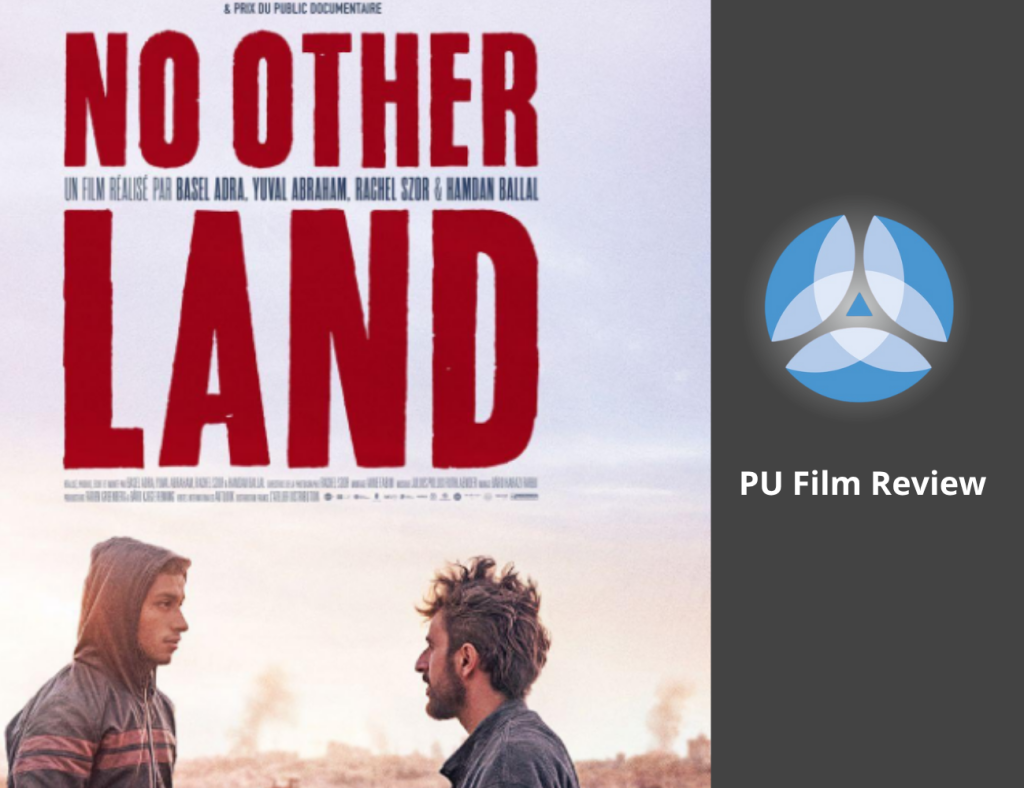
No Other Land is a joint Israeli-Palestinian film which won Best Documentary Feature at the 2025 Academy Awards. I had the opportunity to see it recently.
The film’s Palestinian co-director Basel Adra lives in an area of 20 small villages in the West Bank called Masafer Yatta. The area is noteworthy for its embrace of nonviolent resistance. Basel’s first memory, at age 5, is of his father being arrested, by Israeli troops, for protesting.
As the region has been designated a training ground for the Israeli military, all the homes here are under an eviction order issued by the Israel Supreme Court. Hundreds of demolition orders for homes have been issued, and we watch as a sunglass-wearing, clipboard-carrying bureaucrat oversees each of these demolitions.
A lawsuit brought by Palestinians had slowed the process, but eventually the Court ruled in favor of the army. A leaked document reveals that the express purpose of designating the area as a training ground was to block the expansion of local Arabs. The army is ostensibly using the land for tank training, but in fact Jewish settlements are being built all over the area.
Throughout the film we witness various and continuing scenes of destruction: a playground is demolished; a village well is filled with concrete. Bulldozers demolish homes as families stand by, children crying, women berating the soldiers who guard the process. “How do they expect us to forget where we were born?” they cry. “We have no other land.”
During one demolition, an Israeli soldier shoots and wounds Basel’s uncle, who becomes paraplegic. Basel’s family house has been destroyed; they are now living in a cave, not the most sanitary conditions for the wounded relative. Denied access to travel to seek medical care, we see him wasting away. Eventually he dies.
Co-director Yuval Abraham, an Israeli, becomes friends with Basel, and it is this friendship which offers a note of hope. If an Israeli and Palestinian can become close (and this happens with regularity among peace activists and others), we see possibility for peace in Palestine. Still, any progress in reversing the encroaching demolition is slow-going.
“You’re enthusiastic,” Basel says to Yuval. “You think you can change things here in ten days. This has been going on for decades. You need to get used to failing.”
In other words, to resist takes time. One drop is not going to change anything, Basel emphasizes, but over time things can change.
And indeed, some protests have an impact. After concerted demonstrations, there are fewer demolitions. We also see archival footage of a visit by former UK PM Tony Blair, and its impact: demolitions stop in that village.
But the overall trajectory does not look favorable. Complicity between the military, courts, and Netanyahu government allows more and more Palestinian villagers to be pushed from their homes, and more Israeli settlers to build on these lands.
Other freedoms are increasingly restricted. For example, all Palestinian cars in this area have been confiscated by Israeli authorities. Passage is only allowed for Israeli cars.
Meanwhile, Yuval films another demolition. A Jewish settler films him in turn and threatens, “You’re on Facebook now. People will see you and come pay you a visit.”
Hatred is written on this man’s face. The settlers come across as thugs, especially when they attack while the army stands by, watching. We watch as one settler fires a gun into the stomach of an unarmed villager and then retreats.
In another harrowing scene, children are studying in the local elementary school. As the bulldozers approach, they scream, cry and run, while the school is demolished.
We know this region is home to complicated historical factors and competing claims. Both military sides and leadership in the conflict have committed atrocities and abused trust. But the power imbalance between Israel and Palestinians is clear, and lends credence to the claim of this being an apartheid state. No real progress will take place here without a change of attitudes, a change of heart. Dogmatic religious beliefs, as well as political and economic interests on both sides fuel hatred, anger, and violence. The ongoing intransigence and the dehumanization results in excessive human suffering. No Other Land calls upon us to recognize the humanity in all of us, that everyone ultimately wants to live in peace, to raise our families, to find happiness. This understanding is the only way out.
Every week another family must decide: Endure this oppression, or leave. If they leave, they lose their land. But most villagers stay.
“They destroy us slowly,” one says. “But Masafer Yatta exists for one reason: people who hold onto life.”